

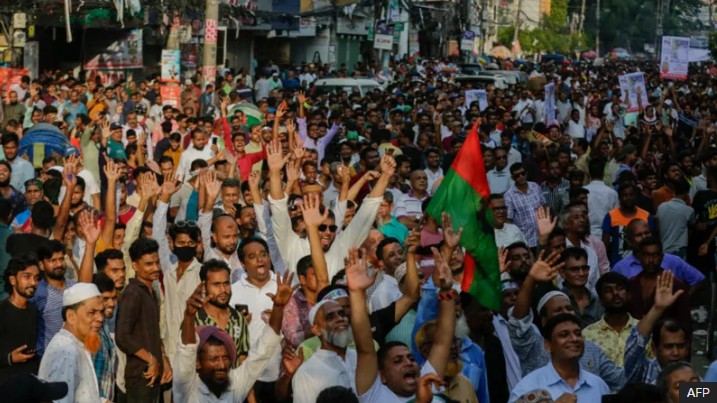
The flight of Sheikh Hasina from the country in the face of the July mass uprising has forced the Awami League to confront a new reality. Not only Sheikh Hasina, but almost all of the party’s top leaders have either fled abroad or are now standing trial. Political upheavals occur in many parts of the world, but the simultaneous downfall of nearly all senior leaders of a ruling party—along with the heads of law enforcement agencies and key state institutions appointed by that government—is a rare event in global history. This signifies the extent to which the former ruling party had politicised the state apparatus and used government officials as instruments of partisan loyalty.
In the aftermath of these events, Bangladesh faces multiple challenges: the law and order situation has deteriorated, and incidents of mob violence have increased. Yet, alongside these difficulties, new possibilities have also emerged. A new kind of intellectual, academic, cultural, and civic realignment can be observed in the country. The old Awami League–centric order has collapsed, giving rise to a fresh wave of historical reassessment and social analysis. Particularly noteworthy is the attempt by political parties to build consensus through dialogue—an encouraging development.
However, some parties have repeatedly sought to create divisions within the process of reconstructing the future state framework, which is being shaped through discussions between the political parties and the Consensus Commission. The refusal of certain parties to sign the July Charter has sparked new debates and disagreements. Even so, the ongoing efforts to resolve political differences and divisions through dialogue must be regarded as a positive step forward.
For example, take Tarique Rahman’s pledge to plant 250 million trees and to dredge canals. The policy team has developed not only a plan specifying where, when, and how these trees will be planted, but also a system to monitor and nurture them using modern technology.
The political history of Bangladesh is one of power struggles and violence. A major cause of this violence has been deep disagreements over the electoral system and the ruling party’s determination to cling to power. Following the fall of the Awami League government, the political parties now active in Bangladesh’s political arena have reached an understanding that only a caretaker government can ensure free and fair elections in the future. There is broad agreement—formed through interparty discussions—on key reform proposals, including setting a time limit for a person’s tenure as prime minister, introducing an upper house of parliament, and reforming the judiciary, police, media, and election commission.
I believe the Bangladesh Nationalist Party (BNP) has played a major role in building this political consensus—particularly as it is the leading contender to win the upcoming election and form the next government. When smaller parties that are unlikely to assume power agree to reform proposals, and when the BNP does the same, the principle may be identical—but the level of responsibility differs. This is because the duty to implement these reforms will ultimately fall on the next government. In that sense, the BNP’s agreement with most of the proposed reforms is not merely a symbolic gesture—it signals a shift in the party’s approach to governance and future planning.
Moving away from the traditional politics of violent movements and displays of power, a politics based on the competition of ideas could bring significant changes to Bangladesh’s social and political structure. If other political parties, like the BNP, also present their policy commitments to the public in a detailed and transparent manner, citizens will be able to choose which party’s policies align best with their own expectations
The BNP’s acting chairman, Tarique Rahman, made this direction clearer in his recent interview with BBC Bangla and in several of his speeches over the past few years. His comments displayed maturity and depth, showing firmness on issues such as the trial of crimes against humanity, foreign policy, and a vision for moving the country forward. These have drawn considerable attention and praise. Yet one recurring theme in his recent remarks—though highly relevant to contemporary Bangladeshi politics—has not received enough discussion. That is his emphasis on replacing political rivalry based on street power and violence with one grounded in principles and policies. In other words, competition among political parties should be driven by ideas and policies, not by displays of muscle or confrontation.
Encouraged and guided by Tarique Rahman, the BNP has already formed several expert-based policy teams to prepare for this new kind of principle-driven politics. These teams have identified the country’s fundamental problems and are working to devise practical solutions that could be implemented if the party comes to power. In the first phase, expert groups have drawn up proposals focusing on education, healthcare, the environment, agriculture, the blue economy, and job creation.
It is worth noting that this policy framework differs from a conventional election manifesto. A manifesto generally contains brief pledges, whereas this policy plan provides detailed outlines—allowing voters to see exactly how each initiative would be implemented. For example, take Tarique Rahman’s pledge to plant 250 million trees and to dredge canals. The policy team has developed not only a plan specifying where, when, and how these trees will be planted, but also a system to monitor and nurture them using modern technology.
The BNP has drawn up plans to excavate 20,000 kilometers of canals and to restore rivers across the country. It is also developing detailed programmes on modern waste management and renewable energy. Every plan takes into account the empowerment of marginalised communities. The BNP also intends to modernise disaster management—based on expert recommendations—to reduce casualties from fires and other calamities. Alongside environmental protection, special emphasis is being placed on healthcare, education, and agriculture.
A key aspect of this new politics and development vision is shifting the focus from showy, visible development and mega projects to improving the quality of life for ordinary citizens. The most important element of principle-based politics is public inclusion—ensuring that the benefits of development reach both the rich and the poor alike. Development will not be confined to a single class or a single political group.
Moving away from the traditional politics of violent movements and displays of power, a politics based on the competition of ideas could bring significant changes to Bangladesh’s social and political structure. If other political parties, like the BNP, also present their policy commitments to the public in a detailed and transparent manner, citizens will be able to choose which party’s policies align best with their own expectations. In most democratic and economically strong countries, political competition is based on ideas and policies—Bangladesh, too, should now embark on that journey.
The views expressed are the author’s own.
Source: prothom alo online.