
Garments made with US cotton to receive tariff benefits under reciprocal trade agreement
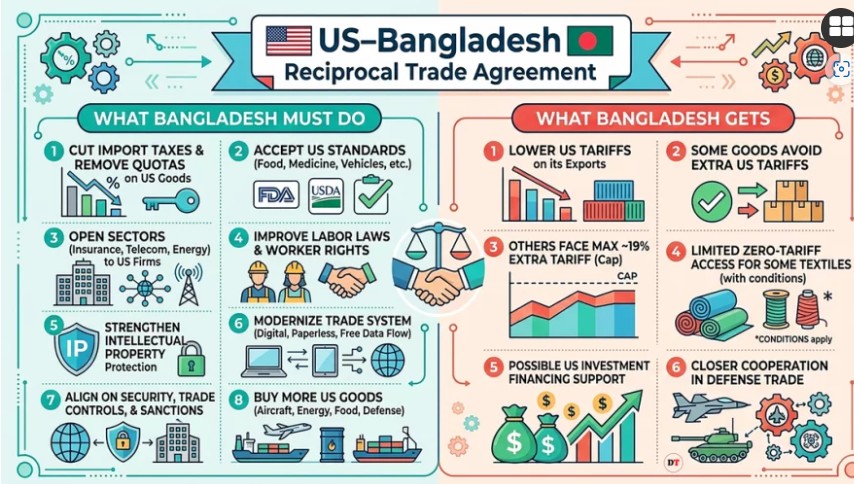
The Agreement on Reciprocal Trade (ART) signed between Bangladesh and the United States is expected to strengthen foreign investment inflows, enhance energy security, and improve Bangladesh’s integration into global supply chains, Foreign Minister Khalilur Rahman told Parliament on Wednesday.
Responding to a question from MP AKM Fazlul Haque Milon during a parliamentary question-and-answer session chaired by Speaker Hafiz Uddin Ahmad, the minister highlighted the potential economic benefits of the agreement, which was signed on February 9, 2026, three days before the national election.
Khalilur said that under the agreement, Bangladeshi apparel products manufactured using US-produced cotton will be eligible for tariff benefits in the American market. According to Article 5.3 of the agreement, the United States has committed to establishing a mechanism that would allow qualifying Bangladeshi textile and apparel products to enter the US market at a zero reciprocal tariff rate. The volume of products eligible for the facility will be linked to Bangladesh’s imports of US-produced cotton and man-made fibre.
The foreign minister said expanding export markets, diversifying export products, attracting international investment, and achieving employment-oriented economic growth remain among the government’s top priorities.
To advance these objectives, he noted, the Ministry of Foreign Affairs is working closely with the Bangladesh Investment Development Authority (BIDA), the Bangladesh Economic Zones Authority (BEZA), and the Ministry of Commerce to strengthen economic diplomacy and attract foreign investment.
Khalilur also said Bangladesh has expanded its commercial engagement beyond its traditional markets in Europe and North America, increasing its presence in emerging markets across the Middle East, Africa, Southeast Asia, South America, Central Asia, and Eastern Europe.
As part of efforts to secure greater market access and tariff preferences, Bangladesh is pursuing Preferential Trade Agreements (PTAs), Free Trade Agreements (FTAs), and Comprehensive Economic Partnership Agreements (CEPAs) with several countries. Discussions on a CEPA with the United Arab Emirates have already begun, while negotiations for FTAs with Malaysia, Singapore, and Thailand are progressing. The government is also seeking stronger engagement with regional economic blocs such as the GCC and MERCOSUR.
The minister further noted that diplomatic initiatives are creating new opportunities for agricultural and non-traditional exports. Bangladesh recently secured access to export potatoes to Vietnam, while efforts are underway to open the Malaysian market for Bangladeshi mangoes.
In response to a separate question from Feni-2 MP Joynal Abdin, Khalilur said the government remains committed to strengthening Bangladesh’s global presence, advancing economic diplomacy, and improving services for expatriate Bangladeshis.
Under the government’s “Bangladesh First” policy, measures are being taken to make the country’s diplomatic infrastructure abroad stronger, more effective, and more cost-efficient. Currently, chancery operations are conducted in government-owned buildings in 20 diplomatic missions across 17 countries, with four additional projects under implementation.
The remaining missions operate from rented premises, costing the government approximately Tk 100 crore annually, the minister added.
The foreign minister also said establishing permanent diplomatic facilities abroad is considered a long term investment. New chancery buildings and state-owned diplomatic complexes are being developed, which will reduce government expenditure over time while enhancing Bangladesh’s prestige and diplomatic effectiveness.